Women Strengthening Economic and Environmental Preservation in Pati

Women Strengthening Economic

Women Strengthening Economic

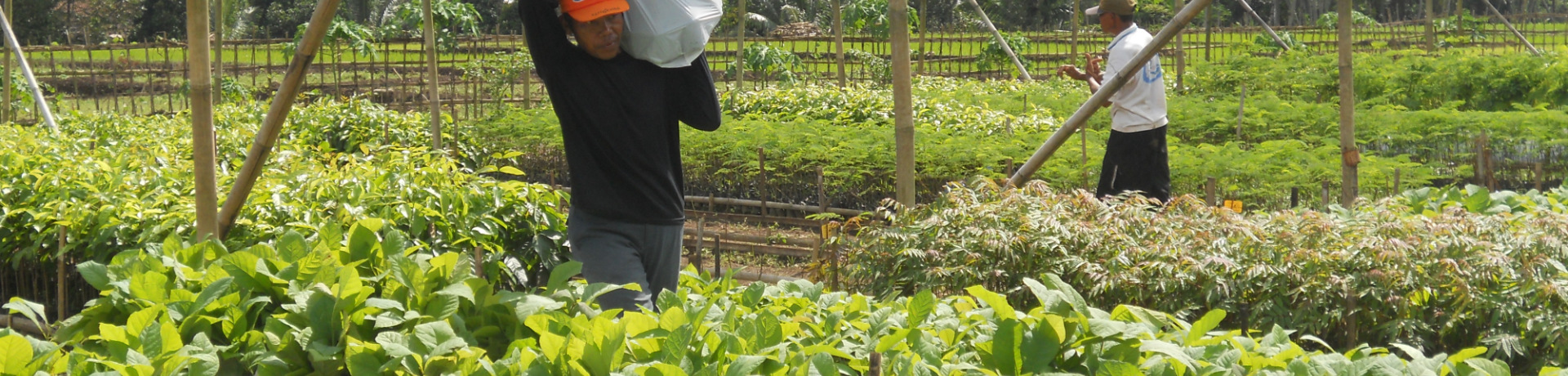
Medani Village in Pati Regency, Central Java, is home to communities whose livelihoods depend heavily on the land. Coffee, cloves, rice, and cassava are among their main commodities and key sources of income. With agriculture playing a central role in daily life, women’s participation in farming is remarkably high. Many are involved in every stage of cultivation.  

“Most housewives usually help our husbands manage the farmland, so we can contribute to improving our family’s income,” said Susanti, one of Medani Village’s women farmers and a Trees4Trees farmer partner. 

Together with their husbands, these women work hard to build decent livelihoods through farming while keeping alive the agricultural traditions passed down through generations in their community. 

Women’s Participation in Farming  

Umi, another woman farmer in Medani Village who is also a Trees4Trees farmer partner and community facilitator, began farming in childhood. Her father was the one who first taught her how to cultivate the land. 

“I once moved to another city to work while studying. But when I realized the income I earned there was barely enough, I decided to return home after getting married and focus on farming with my husband,” she shared. Today, Umi and her husband are able to provide a life for their family through coffee cultivation. She is also supported by a community of fellow women farmers. 

“In Medani Village, it’s not only the men who farm, the women do too. Many of our husbands also work as stonemasons or laborers to keep the household income stable, so as women, we naturally step up to take care of the farming ourselves,” she added. 

Susanti shares a similar story. Coming from a farming family, she focused on agriculture after marriage. “Usually, I handle the watering, fertilizing or harvesting, while my husband takes on the heavier work,” she said. When her husband has other work, she manages the land entirely on her own.  

Women’s strong role in farming is also reflected in the Trees4Trees program. “In the area I manage, 70% of Trees4Trees farmer partners are women, so women’s participation in farming in this area is truly high,” Umi revealed. 

Women Strengthening Economic
Umi and her toddler son. Amid the responsibilities of motherhood, the women remain committed to farming to build better lives for their families.

Strengthening Local Income and Restoring Environment 

Women’s participation not only supports family finances but also strengthens Medani Village’s local economy. As the area is well-known for producing coffee and cloves, their presence helps sustain and enhance this production. 

“Our main commodity is robusta coffee with extraordinary bean quality. We only pick the red ones to keep the quality and competitive price,” said Umi. Cloves are another important source of income. “The price of cloves is also competitive, that’s why, besides coffee, I also rely on cloves,” Susanti said. 

Despite these promising results, farming practices in Medani Village face serious challenges. The village lies across rocky hills and steep slopes, making the land increasingly fragile and prone to erosion and landslides. “The worst landslides usually happen during heavy rainfall. Sometimes the roads are completely blocked, making it difficult for us to reach our farmland,” Umi explained. 

For Umi and other women, planting trees is a key solution, making the women farmers’ role has become increasingly important in environmental restoration. “This is why we plant trees alongside our crops. We need more trees on the slopes, especially where tree cover is limited, to help reduce the risk of landslides,” she added. 

Women Strengthening Economic
(Above) Susanti amidst coffee trees she planted. (Below) Trees4Trees team assists farmer partners in tree planting.

Women Farmers Trees4Trees Pati

Tree Planting Support 

To support local communities in Pati Regency, including Medani Village, Piyama, a clothing brand, together with Trees4Trees, has planted over 30,000 trees. Besides supporting local livelihoods and empowering women, this initiative also aims to restore the environment by increasing tree cover to reduce severe erosion and destructive landslides. 

“One of the reasons, this is caused by agricultural land management practices by local communities that do not adequately apply conservation techniques, like applying terracing,” Khoirum Minan, Trees4Trees Project Manager said.  He added, this makes tree planting especially urgent in these sloped areas. 

Land degradation in Pati due to unadequate agricultural practice to conservation
Agricultural practices in Medani Village that do not adequately apply conservation techniques increase the surrounding area’s risk of erosion and landslides

Land degradation in Pati due to unadequate agricultural practice to conservation

“Trees we received really support and helped our family’s economy as well as for our surrounding environment. Thank you for the free seedlings provided, especially for farmers in Medani Village,” Ummi said. 

Beyond Pati Regency, Piyama and Trees4Trees have also carried out tree-planting initiatives in Boyolali and Kebumen – Central Java, focusing on combating drought and water scarcity. In total over 80,000 trees have been planted by involving more than 880 local farmers which not only restores the environment but also but also supports communities and empowers women in farming.

Writer: V. Arnila Wulandani. Photos: Y. Dessenita 

Blue Carbon: Coastal Forests on the Frontline of Climate Change

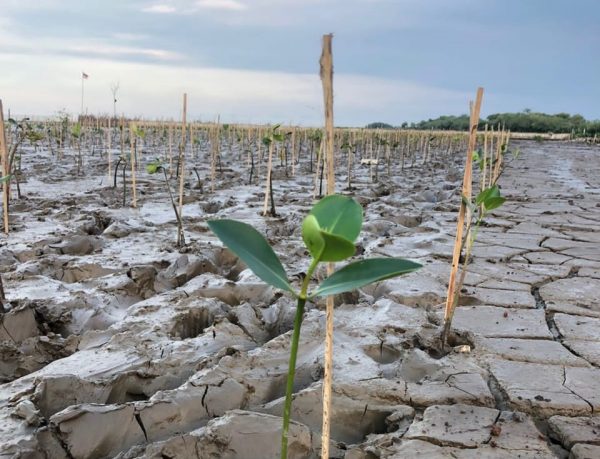
A Trees4Trees mangrove project planted in 2021


Photo: Trees4Trees/Yulianisa Dessenita

How can we combat global warming? Planting trees is a good place to start. Forests are the lungs of our planet. They produce oxygen and absorb the emissions we produce, while also keeping potentially harmful carbon in the ground, where it belongs. 

But when you think of forests, you probably don’t think of coastal and marine ecosystems, right? And yet, these ecosystems store more carbon than anywhere else on Earth. Carbon absorbed and stored here is called “blue carbon”. And blue carbon could be the key to a greener future.  

What is blue carbon and why is it important? 

Blue carbon is the carbon stored in coastal and marine ecosystems. Most of it is carbon dioxide (CO2) that has dissolved directly into the ocean. Lots of blue carbon is stored in underwater sediment, coastal vegetation, and coastal soils. 

Coastal ecosystems can be sea grasses, mangroves, and salt marshes. They all play a crucial role in capturing and retaining carbon. It is for this reason that they’re sometimes called ‘carbon sinks. Although coastal ecosystems are smaller than terrestrial forests, they actually  sequester and store more carbon. 

Unlike in tropical forests, where carbon is stored in above-ground plants, blue carbon is stored below the ground., Some blue carbon can be thousands of years old.  

Did you know? Coastal ecosystems store more carbon per hectare than terrestrial forests. 

A Trees4Trees mangrove project planted in 2021
(Above) A Trees4Trees mangrove project planted in 2021. Photo: Trees4Trees/Yulianisa Dessenita

Coastal ecosystems: Our first line of defense 

Every year, mangroves and coastal wetlands suck ten times more carbon out of the atmosphere than tropical forests. They also store three to five times more carbon.  

When these habitats are damaged or destroyed, all that carbon is released into the atmosphere as harmful greenhouse gases. This makes protecting and restoring coastal habitats essential to combating climate change.  

Healthy coastal ecosystems give us loads of other benefits besides carbon. They offer protection from storms and erosion, provide nurseries for commercial fisheries, and are beautiful places for us to explore and enjoy. 

Did you know? Coastal habitats make up less than 2% of total ocean area, but store around 50% of the carbon sequestered in ocean sediments 

Carbon stored in mangroves ecosystem comparation
The graphic is modified from the original source IUCN

Coastal ecosystems in Indonesia 

In case you didn’t know, Indonesia is huge. This enormous archipelago is home to nearly a quarter of the world’s mangroves, which cover about 3.2 million hectares.

Together with 3 million hectares of sea grasses, these areas store about 3.4 billion metric tons of carbon – that’s 17% of all the blue carbon in the world. 

But despite their massive importance, Indonesian mangroves are under serious threat. Every year, more of these areas are converted into ponds or swallowed up by urban expansion. 

Indonesia emits 190 million tons of CO2-eq every year. That’s 42% of the world’s annual emissions from the destruction of coastal ecosystem services. 

Read more: Five types of mangrove in Indonesia and their benefits 

Trees4Trees mangrove restoration program  

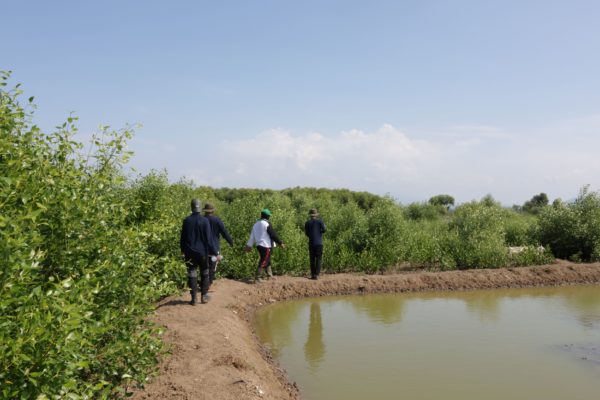
As part of our commitment to support the Indonesian government’s efforts to restore mangrove cover and preserve blue carbon stored in coastal ecosystems, Trees4Trees has been busy replanting mangroves in Central Java. 

A sea cucumber and mangrove seedling in Dukuhseti coastal area, Pati.
(Above) A sea cucumber and mangrove seedling. Photo: Trees4Trees/V. Arnila Wulandani

“From 2021 to 2022, we successfully planted more than 100,000 seedlings in seven coastal villages in Pati,” explains Khoirum Minan, Trees4Trees Pati Unit Manager. “We aim to prevent tidal surges that can erode shorelines and pose a threat to residential areas and fishponds owned by local communities,” he added

The benefits of Trees4Trees mangrove planting mission in Central Java can already be clearly seen. “Mangroves we planted in 2021 have formed a green belt,” says Mustofa, the farmer group leader in Dukuhseti village in Pati. The ecosystem has taken shape, and we often observe birds, fish, and crustaceans in these newly restored mangrove areas.”  

Did you know? It’s estimated that 83% of the global carbon cycle is circulated through the ocean. 

Elsewhere in Central Java, Trees4Trees recently planted 7,600 plants in an area of mangroves spanning 2.4 hectares in Segara Anakan, Cilacap., This previously degraded mangrove ecosystem is now thriving.  

This small-scale pilot project was a chance for us to try out our planting methods before the time came to tackle a bigger challenge. And that time has now arrived.  By 2027, Trees4Trees aims to plant 3.5 million trees in an area covering 1,000 ha in Cilacap, Central Java. 

Read more: Replanting mangroves rebuilding future in Central Java 

“Our project aims to restore the degraded mangrove ecosystems, enhance mangrove species diversity, promote fish populations and biodiversity, and eliminate invasive weeds that disrupt the mangrove growth,.” says Armin Mubarok, the Trees4Trees Impact Officer leading the mangrove planting program in Cilacap. 

Mangrove planting in Cilacap
(Above) Mangrove planting in Cilacap. Photo: Trees4Trees/Haryadi

Through our mangrove planting efforts, Trees4Trees is working to restore degraded mangrove ecosystems and build new green belts along Indonesia’s precious coastlines.  

Together with our local partners, we’re working to preserve blue carbon, and provide lasting benefits to people and nature.  

Writer: V. Arnila Wulandani. Editor: Christopher Alexander

Taking Out the Trash: Combating Plastic Pollution in Java


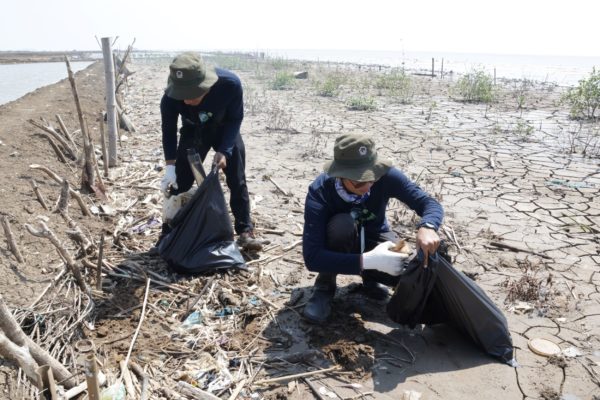
Beach clean up by Trees4Trees team
Taking Out the Trash: Combating Plastic Pollution in Java

Plastic waste on shorelines and riverbanks can be a depressing sight. But the trash we see is just the tip of the iceberg. It’s estimated that 400 million tons of plastic are produced annually. And around 14 million tons of it ends up in the ocean. That’s the equivalent of two garbage trucks of plastic dumped into the sea, every minute of every day. For a year. 

This tide of trash doesn’t just come from the coast. Garbage from inland is swept into waterways and rivers by rain and wind (and people), then transported to the sea. But its journey doesn’t end there.  

When plastic waste enters the ocean, it also enters the food chain. Plastics are eaten by marine life, causing severe injuries and death.  

Plastics also poison the environment itself. These materials are especially deadly to mangrove forests, as they entangle and choke the roots, reducing oxygen levels in the soil and causing the slow demise of plants and the animals that rely on them for food and shelter.

Turning the Tide on Trash 

Tackling plastic waste is a big challenge. But solutions are out there, and every little helps. Working with a team of partners and volunteers, Trees4Trees recently got to work on a beach clean-up program spanning 1.2 miles (2 km) of mangroves and coastal ecosystems near Dukuhseti Village in Central Java’s Pati Regency. The activity was part of Trees4Trees’ 15th anniversary celebrations and were timed to coincide with World Ocean Day and World Environment Day. 

Mustofa is one of Trees4Trees’ local partners. During the clean-up operations, he revealed the impact plastic continues to have on Dukuhseti. “This pollution not only damages the soil,” he explains. “I worry that the huge amounts of plastic waste we see here will also damage the mangroves cover in the area and break up the green belt we have created.”   

Khoirum Minan is the Pati area Unit Manager for Trees4Trees. He agrees that something needs to be done to protect mangroves and restore ecosystem health. “Plastic waste hinders the growth of mangroves and leads to their death, so we have to do something to protect them,” he said. 

During their clean-up operations, Khoirum and Mustofa recovered a diverse array of waste items, which collectively illustrate the scale of the problem. Their haul included countless plastic bottles and items of food packaging, along with weird and less-than-wonderful items like sandals, diapers, sanitary pads, and even a mattress (not the kind of seabed that marine conservationists are used to). 

plastics waste in beach
(Above) Unpacking the problem. Food packaging and other plastics are a common sight in the rivers, waterways, and coastal regions of Java, where pollution is reaching a crucial tipping point.
Taking Out the Trash: Combating Plastic Pollution in Java
(Above) Clean-up operations by Trees4Trees mobilized a team of volunteers and partners along more than a mile of coastline in Pati Regency

Cleaning Up Tourism Hotspots 

Another location where Trees4Trees has been busy recently is Cemara Sewu beach, a popular tourism destination that’s in danger of being ruined by plastics. “During our clean-up activities, we discovered loads of food and drink packaging left by visitors,” explains Rizky Praditya, Trees4Trees’ Kebumen area Unit Manager. “If we don’t clean up the waste here, the pollution will soon affect other areas too,” he warned. 

Taking Out the Trash: Combating Plastic Pollution in Java
(Above) Members of the Trees4Trees team, cleaning up Cemara Sewu beach in Kebumen, Central Java

Changing Attitudes on the Citarum River 

To really make a difference to plastic pollution, you need to go to the source. This means traveling upriver. As Mustofa explains, “so long as people keep throwing trash into the river, the shore will always be polluted with plastic waste and so will the ocean.” 

With that in mind, Trees4Trees began working on clean-up operations in the tributaries of the Citarum River, which is sadly famous for its polluted waters. Focusing on the Cidadap and Rawabogo rivers. Trees4Trees got to work alongside local communities, village officials, and young environmental activists. 

Read also: Travels in Java: Situ Cisanti and the Source of the Citarum River

Taking Out the Trash: Combating Plastic Pollution in Java
(Above) Working with local communities to clean up the Cidadap River in West Java


Taking Out the Trash: Combating Plastic Pollution in Java
(Above) Filling sacks with plastics and other trash, removed from the Rawabogo River

“Cidadap river flows near residential areas,” says Asep Denis, the Ciminyak 3 Unit Manager. “The residents here have a habit of throwing their waste into the river,” he added. According to Mahesa, the Ciwidey Unit Manager, this makes community involvement an essential part of clean-up operations.  

“We’re working to raise awareness in local communities, encouraging their involvement in keeping the river clean,” he said.  

The problem of plastics can sometimes seem like a mountain to climb. But with various clean-up actions already being carried out in locations across Java, Trees4Trees and partners are taking steps in the right direction. Whether cleaning beaches, clearing rivers, or changing attitudes in local communities, the only way is up. 

Writer: V. Arnila Wulandani. Editor: Christopher Alexander

“Trendy and Engaging”: Yutaka Farm Makes Mangroves Fun

“Trendy and Engaging”: Yutaka Farm Makes Mangroves Fun
Photo: Doc. Yutaka Farm

Located in Pasucen Village, some 8 miles (13 km) from the center of Pati Regency, Yutaka Farm is an outdoor café with a connection to nature. From the moment visitors set foot inside, they are greeted with lush greenery and plenty of photo-friendly corners. Artfully arranged bamboo decorations add to the beauty of gardens bursting with plants, flowers, and trees.  

At Yutaka Farm, visitors can grab a bite to eat or get some refreshment in delicious dishes and beverages, capture stunning photos, and enjoy live music performances. There’s also plenty of fun activities to explore, which reveal the magic of plants. 

A place where reforestation education takes centerstage 

The founder of Yutaka Farm is Andi Lestari. From day one, his dream was to build an educational center that grew tree seedlings and helped children and young people get involved in conservation. In the beginning, youngsters were non-plussed by the farming concept. Andi knew he had to jazz things up a bit. 

“This place is a part of our mission to introduce the concepts of reforestation and agriculture in a trendy and engaging way,” explains Andi. “By adopting this approach, we aim to grab the public’s attention, particularly children and young people.”  

“Trendy and Engaging”: Yutaka Farm Makes Mangroves Fun
(Above) Yutaka Farm café – a place of recreation, relaxation, and restoration. Photo: Doc. Yutaka Farm

Andi believes that by grabbing kids’ attention first, he can spark their interest in planting trees. “This also involves the preservation of the mangrove ecosystem in Pati, which needs serious protective measures,” explains Andi. 

At Yutaka, Andi introduces visitors to plants in some creative ways. With an emphasis on play and entertainment, Yutaka Farm has become a hub for the local community since it opened in 2019. Now, every weekend and on public holidays, the farm is packed with visitors. 

Restoring mangroves along the Pati coastline 

Andi is deeply concerned about the recent decline in Pati’s mangroves. Yutaka Farm was born out of his dedication to their preservation and restoration. Since 2009, he has been cultivating mangrove seedlings and then replanting them in the wild. 

mangrove seedling
(Above) Mangrove seedlings are integral to the future health of people and nature in Pati. Photo: Trees4Trees/V. Arnila Wulandani

In addition to cultivating mangrove seedlings, Andi is an activist and educator who is involved in many mangrove restoration projects and activities, both as a founder and as a volunteer. Yutaka Farm is just one of many ways in which he is working to protect mangroves in Pati. 

He believes the future of these important ecosystems depends on local kids becoming interested and getting involved in conservation. He also believes the well-being of the community is directly linked to the health of mangroves. 

“Mangroves are essential to coastal areas in Pati, because they prevent erosion,” Andi explains. “When powerful waves struck the shores of Pati in 2022, places without mangrove coverage were hit harder compared to those with mangroves.” 

Working with Trees4Trees  

To really make a difference, Andi and his Yutaka Farm need help. “We cannot accomplish this task alone,” he says. “Local communities, institutions, and the government need to work together to raise awareness of mangroves and their importance to places like Pati.” 

“In 2021, we partnered with Yutaka Farm to produce 30,000 mangrove seedlings,” says Khoirum Minan, the Trees4Trees Unit Manager in Pati. “The following year, our production increased significantly, surpassing 100,000 seedlings – we have now successfully planted them at several locations in the coastal areas of Pati.” 

Mangrove replanting in Pati is an integral part of Trees4Trees’ long-term commitment to supporting the government’s vision for the region. Working alongside Yutaka Farm, Trees4Trees is creating a green belt along the coast, helping to restore natural ecosystems while also protecting the well-being of local communities inland. 

“Trendy and Engaging”: Yutaka Farm Makes Mangroves Fun
(Above) Andi Lestari at Yutaka Farm in Pati Regency. (below) Mangrove planted in Pati coastal areas. Photo: Trees4Trees/Yulianisa Dessenita
mangrove
Writer: V. Arnila Wulandani

Replanting Mangroves, Rebuilding Futures in Central Java

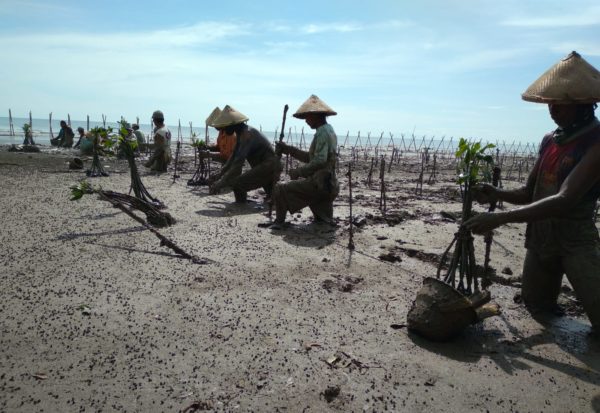
Trees4Trees has been working with local communities to replant mangroves in Central Java
Trees4Trees has been working with local communities to replant mangroves in Central Java. Photo: Doc. Trees4Trees

On New Year’s Eve, Pati Regency in Central Java was inundated by heavy rains. This caused flooding that destroyed more than 600 hectares of agricultural land and damaged thousands of homes. But there was one silver lining to the black clouds that surrounded Pati in December – residents noticed that the areas least affected by the floods were also places with the highest coverage of mangrove forests.  

From the wreckage came the green shoots of a solution. Now, with support from local government and outside help from investors like EcoMatcher, Trees4Trees is working with communities in Pati to restore mangrove forests and rebuild for the future.  

Read also: Mangrove Planting Program with EcoMatcher Inspires Villagers to Plant More Mangrove Trees

A Rising Tide: Building Awareness of Mangroves 

“In recent years, local people’s awareness of mangroves has increased,” says Fauzan Timurlang, who is the Trees4Trees Unit Manager in Pati. He believes the benefits provided by mangroves have become clearer since the recent floods, with many people ready to take action. “They have seen that mangroves can act as barriers that break the waves and reduce the damaging impact,” he explains.  

Andi Lestari is a mangrove activist in Pati, working alongside Trees4Trees. He too has noticed an increase in community awareness. “Many people have seen for themselves the great benefits of mangroves,” he explains. “They have seen that areas with mangrove cover suffer less damage compared to areas that did not have any,” he added. 

Read also: The Incredible Benefits of Mangroves Ecosystem  

Root and Branch: Combining Community Action with Government Support 

Pati Regency stretches 37 miles (60 km) along the coastline of Central Java. Officials here have decided to double mangrove coverage from 300 to 600 hectares, effectively creating a natural barrier that can prevent coastal erosion and protect local homes and livelihoods from flooding. 

“We want to create a green belt from Pencangaan to Puncel,” explains Edy Martanto, Head of the Maritime Affairs and Fisheries Service (DKP) for Pati, in a recent interview with Muria News. “The green belt will function like a beach embankment – if there are waves, the mangroves will form a barrier – when the mangroves are strong, the ponds are also safe.”  

(Above) In areas like Kalikalong village in Pati Regency, Trees4Trees has been working to double mangrove cover

Planning into Planting: Trees4Trees Takes Action in Pati 

To help bring this green belt to fruition, Trees4Trees began planting mangroves along the Pati coastline from November 2022 to January 2023, as part of the recent planting season. By employing members of the community from eight local villages, Trees4Trees has already planted a total of 108,000 mangrove trees in an area covering 24 hectares.  

These seedlings (consisting of Red Mangrove or Rhizophora mucronata and White Mangrove or Avicennia marina), are endemic to the area, so will help replenish wild populations. They are currently being monitored to ensure they stay healthy and continue to grow. Back in 2021, and with support from EcoMatcher, Trees4Trees also planted around 30,000 mangrove seedlings across 3.8 hectares surrounding Dukuhseti village.

Read also: Mangrove Types in Indonesia and Their Benefits


Trees4Trees has planted more than 138,000 mangrove trees in Pati since 2021.

“The thicker the mangrove cover, the safer our fishponds will be – that’s why we’re so keen to be a part of the Trees4Trees mangrove planting program.”  Musthofa, Tani Makmur farmers’ group 


Local Communities on the Frontline of Mangrove Restoration 

To ensure mangrove restoration takes root in Pati, Trees4Trees has also involved local village officers and members of the forestry service. Six groups of local fishpond farmers have also been employed as mangrove planters.  

“Farmers in our group have become aware of the benefits provided by healthy mangrove ecosystems,” explains Musthofa, leader of the Tani Makmur farmer group. “The thicker the mangrove cover, the safer our fishponds will be; that’s why we’re so keen to be a part of the Trees4Trees mangrove planting program,” he added. 

(Above) Parmi is one of many fishpond farmers joining in the Trees4Trees planting program in Dukuhseti village

Another of the fishpond farmers who joined the mangrove planting program is Parmi. Like many people here, he makes a living by farming fish and shrimp. With support from Trees4Trees, he is looking forward to a safer and more prosperous future. 

“Thick mangrove cover helps to protect our fishponds from strong waves, resulting in a higher abundance of fish,” explains Parmi. “I hope the mangroves we plant now will grow into a full forest like before, so they can continue to provide benefits for us and future generations.”  

Trees4Trees™ is a non-profit foundation focused on renewing the environment and empowering local communities through reforestation and education. For more information about the work we do, and to make a donation in planting mangroves, please go to devtrees4trees.portopaper.com. 

Writer: V.Arnila Wulandani. Editor: Christopher Alexander.