Environmental Impact Assessment/EIA

Environmental  Impact  Assessment/EIA
An Environmental impact Assessment (EIA) is an assessment of the possible impact—positive or negative—on the environment when a new activity/program is introduced in an area. The assessment  considers natural, social and economic aspects.
The purpose of the assessment is to ensure that possible environmental impacts are considered before deciding to go ahead with the program or designs the program to avoid possible negative impact.
EIA activities started in Block Cikedodong (consists of 4 villages) with identifying environmental factors such as river conditions, biodiversity (vegetation and wild animals) in each land category (e.g. forest, shrub, garden, paddy field, settlement).
Our approach is participatory meaning we work through local institutions and farmers, in fact the process of the Assessment has proven to be an efficient education process which teaches farmers to determine the quality of their environment and to manage it.
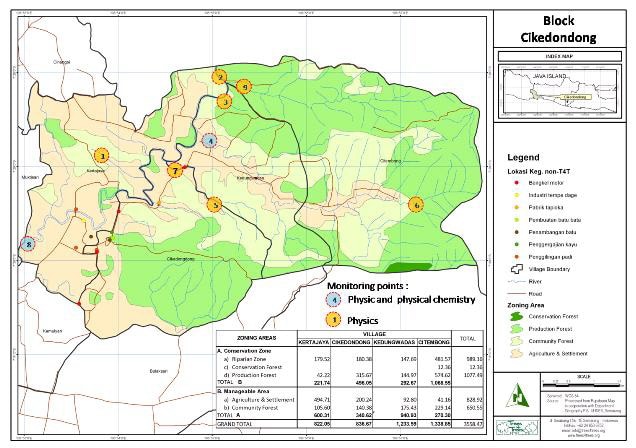
We established 9 SPL (Stasiun Pemantauan Lingkungan/Environment Monitoring Points) to observe  physio-chemical  aspects (in the river), 6 track for wild animal monitoring, and 44 plots for vegetation monitoring.
We work with the laboratorium of Banyumas Agricultural School to analyse  physical samples and with the University of Soedirman-Purwokerto, Faculty of Biological Science/Environment Lab. for chemical analysis (BOD/COD and pesticide contents)

9 Environment monitoring points were established in Block Cikedondong in relevant rivers/streams.

6 Wild animal identification tracks were established in Block Cikedondong representing various land cover/ecological types

44 of Permanent Sample Plots for vegetation identification and monitoring, represented of 4 types of Silviculture
 
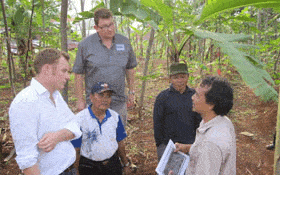
The EIA team,consists of trees4trees staffs and farmer groups.  EIA team (farmers: Kohar, Kholil, T4T : Aris,Novi, Field Coordinator: Badrun)  at Watubelah river, before arriving at the upper course  to measure of water quality
 
Cihaur river is largest river in Block Cikedondong-Cilacap and is part of the scope of EIA study in Cilacap
Kedungwadas (monitoring point no 4) is the second largest river  in Block Cikedondong; the EIA team is here measuring the waterflow rates
 
Dulwarsito, farmer member of Kedungwadas sets up meter stick in monitoring point no 4 to measure the waterlevel at Kedungwadas river  Dulwarsito, measuring water flow use a pingpong ball and stop watch as a simple method which is introduced to the farmers. They also learn to analyse the results.
 
Sample of water from 5 monitoring points  to be analyzed of total suspended solids (TSS) which is an important factor in physical water quality  Novita with a student  practice measuring TSS at the laboratorium of Kalibagor Agriculture School
 
Badrun, field coordinator in block Cikedondong in  night observation of wild animals.  Gibug snake (Agkistrodon rhodostoma), one of the  nocturnal animals in Block Cikedondong found  in track no 10-m.
 
Bird watching in block Cikedondong found  20 bird species. There were 9 birds species categorized as Rare, Treatened, Endangered (RTE)  Tono, a farmer member of Cikedondong is also a local hunter. He taught us where to look and how to look in the night oberservation of wild animals.
Tree Planting

446.025 trees were targeted for planting in December-January 2009-10. Some of areas delayed  the schedule of planting because the rainy season started late. But in January planting got under way, first with West-Central Java and later in the month in East-Central Java.
 
Plot no 30 in Village Padamara_District Purbalingga, planted 650 Suren trees owned by Rislam Sutrisno.  Sakhidi, a farmer in Village Padamara District Purbalingga with his Sengon trees just planted in his plot (plot no 44).  Totally 650 Sengon trees were planted by Sakhhidi.
 
Kamil,  T4T field staff, discusses with Sarjono, the farmer group manager of Patemon, Purbalingga.  Suren trees planted in plot no 57 at Village Patemon, Purbalingga
 
Sugiyono, field coordinator Village Kaliori, District Banyumas with Supardi, a farmer who got 90 teak trees.  Teak trees at plot no.19 owned by Pujiono, a farmer in village Kaliori, planted in  between rice plant.  Totally  450 trees were planted in that area
 
Suren trees planted in plot no 15 owned by Sahrudin a farmer in Village Bulaksari, District Cilacap.  He got 233 trees from the program.  Tree labels indicate ownership and location of planting
 
Kamil, Trees4Trees field staff, explains to farmer how the tree labels are applied.  Supervising teak trees after planting in plot no 7, owned by Sakur at Village Bulaksari, District  Cilacap.
 
Sahrudin, a farmer in village Bulaksari, Cilacap, planted trees beside supporting poles.  Labeling of seedling after planting.
Education Program

We start the environment education program by assessing the students’ knowledge of the subject.   This year’s program started off in the Elementary School (Sekolah Dasar) of Cikedondong 1 located in Village Cikedondong, District Cilacap.
The purpose of the initial assessment  is to deliver educational modules that are appropriate in relation to the knowledge level of students in that area. Knowledge of the environment has proven to vary greatly villages and districts.
Assessment is carried out through interviews with randomly picked students, totally 30, in  Class 4 and 5
 
Elementry School of Cikedondong 1, located in Village Cikedondong, District Cilacap.  Students of class 5, listen to the introduction of Trees4Trees’ education program.
 
Kamil, interview a  student from class 5.  Vyta, local staff, interview a  student.
 
Robiyah a trees4trees liaison teacher, introducing environmental subjects to students.  Students of class 4,listen to the introduction.
Seedling Distribution

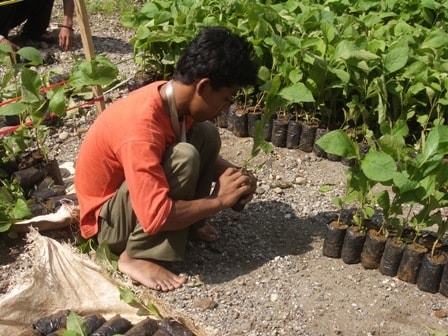
We have transported seedlings from the nurseries to each Management Unit.  The seedlings now need 2-4 weeks to acclimatize to the new surroundings before planting.
Total seedlings distributed amount to 454.946
There will be 3871 farmers (and their families) involved in planting them on 784 hectares of land.
   
Gufron, field coordinator of district Kebumen checks soil condition in the acclimatization area.
Musyafa, Field Coordinator of Bulaksari-Cilacap with teak seedlings that are being checked and selected before distribution to farmers.
   
Tugiyo, field coordinator from Banyumas district supervises seedlings being loaded onto a truck in the nursery
Sugiyono with  seedlings selected for distribution process in Banyumas nursery.
Environmental  Impact  Assessment

Environmental Impact Assessment (EIA) for FMU Cikedondong is a necessary component in developing a management plan for the plantation in that area.
The EIA identifies  significant impacts on environment in connection with the planned activities. (The impacts can be physical, chemical, biological, social;)
The EIA focus on measuring current environmental  factors through interview with communities and directly measuring where possible.
We  use the laboratoriums of local agriculture schools to measure the condition of soil and water.
   
The EIA team in Banyumas  consists of a physics-chemistry group and a biology group.  The red dots on this map of Cikedondong mark the spots for observation of wildlife in the area. Data from this activity is combined with information from interviews with local hunters and farmers to make up a wildlife inventory.
  
The Memmert universal oven is an important piece of  equipment  in the laboratorium  for measuring sedimentation in the river. We do this in  cooperation with the Agricultural school of Banyumas.  A part of the biodiversity assessment is the identification anything that grows within a radius of one meter of the sample plant. The photo shows some of the plants we collected.
Education program

Students of a school in Kebumen  handle seedlings as part of our education program aimed at primary schools.  They learn how select good seedlings before planting.
They engage in seedling maintenance.
  

UK Retailer & Distributor learn more about the Trees4Trees™ Program and it’s activities.

Representatives from leading UK furniture retailer Barker & Stonehouse and the wholesale distributor BakerBedford visited the Trees4Trees program in Central Java to learn more about the program and spend time with some of the program's participating growers.


Empowering local individuals and communities to sustainably manage their planted forests and obtain benefit from the commercial use of these resources is a primary goal of the Trees4Trees™ program.


In Trees4Trees™ plantings a diverse range of timber species are encouraged so that benefits can be maximized for program participants and the environment.


Through planting tree species that mature at different ages we can assist growers to derive income from the harvesting of different tree species at different intervals through the life of the plantings. Integration of fruiting tree species provide additional benefits and potential income or sustenance sources.


"We can really see the value of BakerBedford's contribution to the program and we are very pleased to continue our support.


The program is hands on and it is making a real difference to the lives of local people and to the environment where we source our products.


The progress of the program since our visit 12 months ago is truly amazing. From what we saw on our visit the quality of resources and training that the program staff are delivering to local farmers is of an extremely high standard and should be commended " stated Mark Bedford, Managing Director – BakerBedford.


Since inception, the program has provided seedlings and extension support to more than 9,000 farmers and their families across Central Java.


Trees4Trees program staff work with the farmers to establish what tree species will grow best on their land and suit the farmers management objectives and short, medium and long term plans.


Advice is provided on how best to manage the chosen tree species so that the farmers can maximise their commercial returns through active management of the plantings for the sale of timber to local markets.


Tree management may include form pruning, thinning and spacing and lift pruning to produce higher quality timber which is in demand for furniture and other specialist applications.


Ian Pike, Sourcing Manager, BakerBedford outlined "the complexity of the tree plantings on an individual farmers plot is something to behold. Through the Trees4Trees program farmers are able to select from a range of timber species that will mature at different times.


This allows the farmer to plant up their land with multiple species which will yield income at different harvest times. The Trees4Trees is doing a great job through it's work with the farmers".


Trees4Trees™ is providing tree seedlings of species that have high commercial timber demand to program participants. Species include Teak, Mahogany, Mango, Albizia, Sonokeling, Suren and Mindi.


"It is rewarding to know that the contributions that we are making to the program are positively impacting in the lives of those often less fortunate than ourselves at the retail and consumer end of the supply chain.


We met with local Javanese farmers whom have been gifted trees through the Trees4Trees program.


The farmers have worked with the Trees4Trees field staff to determine what species of trees they should plant to met their needs and long-term management objectives" detailed James Barker CEO Barker & Stonehouse.


The plantings we viewed are now one year old, the plants are growing well with many in excess of 2m in height. The farmers were very proud of their trees and positive about managing their plantings so that they can optimise their return from their tree assets".

Preparation of Seedling Distribution

In preparation for the 2009 planting activities, which will see 470,000 seedlings distributed to 3,871 farmers in early December, the Trees4TreesTM staff developed seedling distribution plans and delivered training on tree planting and establishment with the Trees4TreesTM Area Managers & Field Coordinators. Training was delivered to new field coordinators (9 Field Coordinators and 2 Area Managers) in Banyumas for forest management units in Kebumen and Cilacap.
  
Mr.Taufik, the trainer, explains planting preparation activities to the Trees4Trees Field Coordinators.
Field Coordinators from Kebumen and Cilacap in the training activity at Banyumas.
  
Martoyo, community forest management  section of Farmer Group Berkah Lestari in the seedling selection process.
Sarjono, Farmer group leader  in the selected seedlings at Village Patemon.
Tree inventory

Forest management activities included continued preparation of standing stock inventories with Trees4TreesTM Treegrowers in Cilacap and Pati.  Inventory activities commenced in Purbalingga and Boyolali.
  
Farmer group in Musuk Village-Boyolali in tree inventory training (tree height measurement).  Suyatno and Sutono from the production and marketing section of farmer group Musuk, measuring tree circumference.
Education program

Meetings with 4 Schools  SD Negeri Karangtanjung 2 (Kebumen), SD Negeri Bulaksari 1 (Cilacap), SD Negeri Srowot 1 (Banyumas), SD Negeri 2 Patemon (Purbalingga) were held as part of the School education program. It was agreed with the schools to develop education modules in-conjunction with these schools as a pilot program. The education modules will focus on tree planting and management. The modules will integrate with the existing environment education activities undertaken at the schools. It is intended that the modules will align with the national natural science curriculum.
Establishing Farmer Groups in Kebumen and Boyolali

Workshops were held in Kebumen and Boyolali to establish farmer groups. In Kebumen (9 Farmer  groups), and Boyolali (4 Farmer  groups) were established to work in partnership with the Trees4TreesTM Program.
  
Signing MoU with Farmer Group leader Sumarno at Musuk-Boyolali.  Farmer group in Musuk Village-Boyolali, after signing a collaboration  MoU with Trees4Trees.
 
Signing MoU with farmer group in Karang Tanjung – Kebumen.  Karang Tanjung – Kebumen village leader-leads  the signing event.
Introduction of the  Trees4Trees™ Program with Local Government Departments including District Forestry Departments

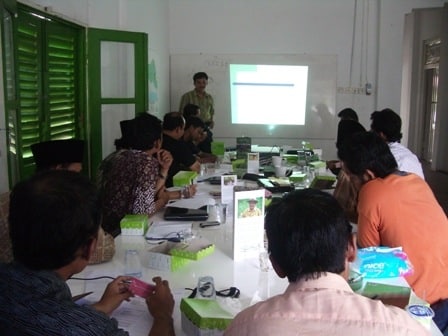
The Trees4Trees™ Program staff held meetings with officials from the Forestry Departments of the Purbalingga, Kebumen, Cilacap, and Banyumas Districts.  Disscussion were held to raise awareness regarding theTrees4Trees Foundation and it's associated program activities. An integral component of the Trees4TreesTM Program is consultation with stakeholders and participants.
  

The Manan & Trees4Trees™ Foundations undertake fund raising activity at Archipelago Fest 2009.

The Archipelago Fest 2009 – Adopt a Tree Initiative is a partnership fund raising activity of the Manan and Trees4Trees Foundations. The event will be undertaken at Supermal Karawaci, Jakarta, Indonesia from the 30th October to the 1st November 2009.


Funds donated through the Archipelago Fest 2009 – Adopt a Tree Initiative will be used to gift trees to Javanese farmers and their families. The gifted trees become the property of the farmer and their family. Farmers will receive tree seedlings of timber species including teak, mahogany, mindi, suren, albazzia and/or mango. All species are grown in Java in community forests and are used in the production of furniture and wood products for international and domestic consumption.


Individuals who donate at the Archipelago Fest 2009 – Adopt a Tree Initiative will receive a certificate acknowledging their contribution. They can also choose to be acknowledged formally on the Trees4Trees™ website.


The Manan Foundation is an Indonesian, non-profit organization with the purpose of developing communities through education in preserving and developing our nation core values and patriotism.


www.mananfoundation.org

Manan Foundation Core Values:

  •  Equal opportunities in learning and self-improvement in all aspects of life.
  •  Caring and respect in the community with a mutual balance of rights and duties.
  • Tolerate and integrate the differences in peace and harmony.
  • Be honest, open, and responsible in every action.
  • Extend positive impact towards the community.


Trees4Trees™ is a non-profit foundation established in Indonesia by responsible furniture manufacturers and their customers worldwide.Trees4Trees™ empowers local communities through partnership reforestation initiatives and related education programs. Increasing the area of community planted and owned forest creates livelihood assets, renews the environment and reduces the negative effects of deforestation.

Trees4Trees™ Participant Profile – OLD JAVA.

Old Java produces fabulous handcrafted furniture combining quality and value. The furniture collection is internationally recognized for its simplicity and style.


The furniture is skillfully created from teak and mahogany (new and reclaimed) and natural materials including leather, rattan and banana fibre. Sound joinery techniques, traditional carving and hand-finishing of the furniture completes the Old Java ‘look’.


The Old Java factory is located south of Jakarta at Gunung Putri, Java, Indonesia and was founded in 1998 by Mark and Jasmine Saunders-Davies. Today, approximately 500 individuals are employed in the production of forty 40 ft containers per month. Products are exported to approximately thirty countries.


Major markets include the UK, Europe, USA, the Middle East, Latin America and Asia. Old Java customers are primarily large retailers and wholesalers, purchasing from Old Java’s extensive collection of over 800 items. Old Java also undertakes contract furnishing for high-end developments and commercial projects.


“With our extensive client base and global distribution we are acutely aware of and concerned about the sustainability of our industry.


Old Java is a member of the Sustainable Furniture Council (USA) and is proactive in the use and sourcing of recycled and sustainable materials for the manufacture of our furniture collection.


We are committed to improving our operations – socially and environmentally”, outlined Mark Saunders-Davies. “We believe that we must take a lead and communicate this to our customers.


As a result, we are taking positive steps and are committed to the replanting of high quality timber resources used in the production of our Old Java Furniture Collection.


Jasmine Saunders-Davies further explained “The Trees4Trees program provides Old Java with an effective mechanism to proactively make a difference in the local Javanese communities where we source our timber.


We are delighted to be involved in the Trees4Trees Program and are very excited about the excellent work that the Trees4Trees team undertakes through tree planting and education in local communities.


In time, the benefits of the Trees4Trees program’s tree-planting, education and training activities will result in the creation of a community forest of a highly valuable cabinet timber resource.


This forest will provide local farmers with income when they harvest their trees. Upon harvest, furniture manufacturers like Old Java, will have access to quality timber for the production of their furniture that will be enjoyed by customers worldwide.


“The Trees4Trees Program is a positive, good news story which Old Java and its customers are keen to support”, stated Mark Saunders-Davies. “The feedback from our customers worldwide in relation to the Trees4Trees program has been overwhelmingly positive”.